15/09/2026
Introduction
The UK design industry continues to offer exciting career opportunities for creative professionals, graduates, and experienced designers. As businesses invest in digital products, branding, customer experiences, and innovative technologies, the demand for skilled design professionals remains an important part of the job market.
Whether you are interested in graphic design, UX/UI design, product design, or interior design , there are several career paths worth exploring in 2026.
For job seekers looking for their next opportunity, understanding which design roles employers are hiring for can help you develop the right skills, improve your CV, and find suitable vacancies.
In this guide, we explore the top 10 design jobs in the UK for 2026 , the skills employers look for, and how you can improve your chances of securing a design role.
Looking for your next opportunity? Explore design vacancies and career opportunities on DesignJobBoard.co.uk .
What Makes Design Careers Attractive in the UK?
Design is no longer limited to creating attractive visuals. Modern designers help businesses solve problems, improve customer experiences, develop digital products, and communicate effectively.
Several factors make design careers appealing:
Digital transformation: Businesses need designers for websites, mobile applications, and digital services.
Technology and innovation: New products and services require thoughtful, user-friendly design.
Cross-industry opportunities: Designers can work in technology, retail, finance, healthcare, education, media, and manufacturing.
Flexible career paths: Some design roles offer office-based, hybrid, or remote working arrangements.
Transferable skills: Research, creativity, communication, and problem-solving can be useful across different industries.
However, competition can be strong, particularly for entry-level positions. A good portfolio, relevant software skills, and practical experience can help candidates stand out.
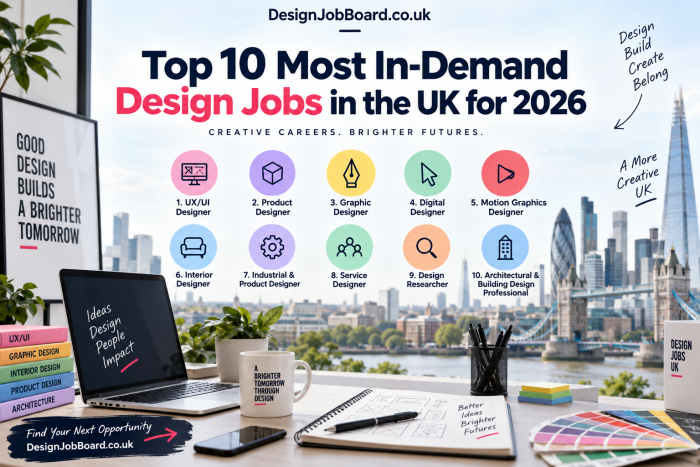
Top 10 Most In-Demand Design Jobs in the UK for 2026
The following roles represent important career opportunities across digital, creative, commercial, and built-environment design. Demand varies by industry, location, and experience level, so this is a practical career guide rather than an official ranking of all UK vacancies.
1. UX/UI Designer
UX/UI Designer is one of the most attractive career options for people interested in digital products and user experiences.
UX designers focus on how users interact with a product, while UI designers concentrate on its visual interface. Many employers combine both responsibilities into a single role.
What does a UX/UI Designer do?
Typical responsibilities include:
Researching user needs and behaviours.
Creating wireframes and prototypes.
Designing website and mobile app interfaces.
Developing user journeys.
Testing designs with users.
Collaborating with developers and product managers.
Improving accessibility and usability.
Essential skills
Figma
Wireframing and prototyping
User research
Interaction design
Design systems
Responsive design
Accessibility principles
Basic HTML and CSS knowledge
Current UK job-posting data identifies Figma, HTML, and Sketch among the frequently requested skills for product design and UX/UI roles.
Who is this career suitable for?
UX/UI design is suitable for creative problem-solvers who enjoy technology, research, and designing digital experiences.
Related job titles: UX Designer, UI Designer, Interaction Designer, Digital Product Designer.
2. Product Designer
Product designers help shape digital or physical products from early ideas through development and improvement.
In the technology sector, product designers often combine UX research, interface design, prototyping, and collaboration with product teams.
Main responsibilities
Understanding customer problems.
Creating user flows and prototypes.
Designing product features.
Working with engineers and product managers.
Maintaining design systems.
Testing and improving product experiences.
Using feedback and data to inform design decisions.
Skills employers may look for
Figma and prototyping tools
User-centred design
Product thinking
User research
Interaction design
Visual design
Communication and collaboration
Basic understanding of front-end development
Recent UK job-posting data shows continuing recruitment for product design and UX/UI positions, with many listings requesting Figma and related digital design skills.
Career opportunities
Product designers may find opportunities in:
Software companies
Fintech businesses
E-commerce
Healthcare technology
Start-ups
Digital agencies
Consumer technology
Tip: Build a portfolio that explains the problem, your design decisions, the process you followed, and the outcome—not just the finished screens.
3. Graphic Designer
Graphic designers help businesses communicate through visual content. They create designs for branding, marketing, advertising, publications, packaging, and digital platforms.
Although digital design continues to create opportunities, graphic design graduates and junior applicants should be prepared for competition. A UK government-published analysis of entry-level hiring reported a decline in entry-level graphic designer hiring in the period it examined, highlighting the importance of practical skills and relevant experience.
What does a Graphic Designer do?
Create logos and brand identities.
Design brochures, posters, and marketing materials.
Produce social media graphics.
Develop packaging concepts.
Prepare artwork for print and digital use.
Work with marketing and communications teams.
Maintain brand consistency.
Essential software
Adobe Photoshop
Adobe Illustrator
Adobe InDesign
Figma
Canva
Affinity Designer
How can you stand out?
A strong graphic design portfolio should demonstrate:
Branding projects.
Digital marketing designs.
Typography and layout skills.
Print-ready artwork.
Social media campaigns.
Consistent visual storytelling.
Related job titles: Junior Graphic Designer, Brand Designer, Visual Designer, Marketing Designer, Creative Designer.
4. Digital Designer
Digital designers create visual experiences for websites, apps, online campaigns, and other digital platforms.
This role is broader than traditional graphic design and may involve visual design, animation, interaction, branding, and digital content.
Typical responsibilities
Designing website layouts.
Creating digital marketing assets.
Developing landing pages.
Designing online campaigns.
Creating animations and motion graphics.
Collaborating with developers.
Improving visual consistency across digital channels.
Skills to develop
Figma
Adobe Creative Cloud
Responsive web design
Typography
Colour theory
HTML and CSS fundamentals
Motion design
Digital accessibility
Digital designers who understand both visual communication and how websites work can be valuable to agencies, technology companies, retailers, and marketing teams.
Career tip: Create a portfolio that includes website designs, landing pages, mobile layouts, and responsive design examples.
5. Motion Graphics Designer
Motion graphics designers create animated visuals for advertising, video content, social media, entertainment, and digital campaigns.
As brands increasingly use video and animation to communicate with audiences, motion design can be a useful specialisation for creative professionals.
What does a Motion Graphics Designer do?
Create animated titles and graphics.
Design promotional videos.
Develop social media animations.
Produce explainer videos.
Animate logos and brand elements.
Work with video editors and creative directors.
Prepare graphics for different screen formats.
Important skills
Adobe After Effects
Adobe Premiere Pro
Cinema 4D or Blender
Typography in motion
Storyboarding
Video editing
Animation principles
Visual storytelling
Where can you work?
Motion graphics designers may work in:
Creative agencies
Advertising companies
Film and television
Gaming
Social media production
Corporate marketing
Freelance studios
Portfolio tip: Include short, well-produced animation samples rather than relying only on static images.
6. Interior Designer
Interior designers plan and develop functional, attractive, and practical interior spaces. They work on residential properties, offices, hotels, restaurants, retail stores, and commercial buildings.
The role combines creativity with technical knowledge, space planning, materials, and project coordination.
What does an Interior Designer do?
Develop interior design concepts.
Prepare floor plans and layouts.
Select furniture, materials, and finishes.
Create mood boards and visual presentations.
Prepare 3D models and renderings.
Coordinate with contractors and suppliers.
Consider building regulations, accessibility, and safety requirements.
Manage design changes and project deadlines.
Essential skills
AutoCAD
SketchUp
3ds Max or Blender
Revit
Adobe Photoshop
Space planning
Material selection
Technical drawing
Client communication
Career opportunities
Interior designers can work with:
Interior design studios
Architectural practices
Property developers
Hospitality businesses
Retail brands
Furniture companies
Construction and fit-out companies
Career tip: Include floor plans, material boards, 3D visualisations, and completed project photographs in your portfolio.
7. Industrial and Product Designer
Industrial and product designers develop physical products that are functional, attractive, and suitable for manufacturing.
They may work on furniture, consumer electronics, household products, medical equipment, packaging, tools, and other manufactured goods.
Main responsibilities
Research customer and market needs.
Develop product concepts.
Create sketches and 3D models.
Select materials and finishes.
Build prototypes.
Collaborate with engineers and manufacturers.
Test products and refine designs.
Consider cost, usability, sustainability, and production methods.
Skills employers may value
SolidWorks
Fusion 360
Rhino
AutoCAD
KeyShot
3D modelling
CAD
Product sketching
Prototyping
Manufacturing knowledge
Materials and processes
Where can industrial designers work?
Manufacturing companies
Consumer electronics businesses
Furniture brands
Automotive companies
Medical device manufacturers
Product development consultancies
Engineering and design studios
Tip: Show how your designs move from an initial concept to a realistic, manufacturable product.
8. Service Designer
Service designers improve the way customers and organisations experience a service.
Instead of focusing only on a website or product, they examine the entire customer journey—including people, processes, technology, and communication.
For example, a service designer might improve how customers book a healthcare appointment, open a bank account, or access a government service.
What does a Service Designer do?
Research customer needs.
Map customer journeys.
Identify service problems.
Create service blueprints.
Facilitate workshops.
Collaborate with business and technology teams.
Develop and test service improvements.
Recommend changes to processes and customer experiences.
Essential skills
User research
Customer journey mapping
Service blueprinting
Workshop facilitation
Problem-solving
Stakeholder management
Systems thinking
Prototyping
Communication
Potential employers
Government organisations
Banks and financial services
Healthcare organisations
Consultancies
Technology companies
Retail and customer-service businesses
Service design is particularly suitable for professionals who enjoy research, strategy, collaboration, and solving complex organisational problems.
A 2026 UK UX careers report identified service design as a distinct role within the wider user-experience job market, although its reported salary sample was relatively small.
9. Design Researcher and User Researcher
User researchers investigate how people think, behave, and interact with products or services. Their findings help design teams make better decisions.
This role is suitable for people who enjoy understanding human behaviour, conducting research, and turning information into practical recommendations.
Typical responsibilities
Plan user research studies.
Conduct interviews and usability tests.
Observe users interacting with products.
Analyse qualitative and quantitative data.
Identify customer needs and pain points.
Create research reports.
Present findings to design and product teams.
Support evidence-based design decisions.
Skills to develop
User interviews
Usability testing
Survey design
Research planning
Data analysis
Presentation skills
Qualitative research
Quantitative research
Ethical research practices
Where can you work?
User researchers may find opportunities in:
Technology companies
Universities
Government departments
Financial services
Healthcare
Consultancies
Research agencies
Career tip: Your portfolio should explain your research question, methodology, findings, and how your recommendations influenced a design or service.
10. Architectural and Building Design Professional
Architectural and building design roles offer opportunities for people interested in buildings, construction, sustainability, and the built environment.
Depending on the position, professionals may work on residential buildings, commercial developments, infrastructure, renovations, and large construction projects.
This category includes several related career paths, such as architectural assistant, architectural technologist, building designer, and CAD technician.
What do architectural and building designers do?
Develop building concepts.
Prepare technical drawings.
Create plans and elevations.
Produce 3D models.
Coordinate design information.
Work with engineers and contractors.
Consider building regulations and accessibility.
Support planning and construction documentation.
Essential skills
AutoCAD
Revit
BIM
SketchUp
Technical drawing
3D modelling
Building regulations awareness
Construction materials knowledge
Project coordination
Career opportunities
Professionals may work in:
Architectural practices
Construction companies
Engineering consultancies
Property development
Local authorities
Building design studios
BIM consultancies
Tip: If you are applying for UK architectural or building design positions, research the qualifications and professional requirements associated with the specific job title.
Essential Skills for Design Jobs in the UK in 2026
Employers increasingly look for designers who can combine creativity with practical, technical, and communication skills.
Here are some valuable areas to develop.
1. Design Software
The software you need depends on your specialisation.
Design area
Useful tools
UX/UI design
Figma, Sketch, Adobe XD alternatives and prototyping tools
Graphic design
Photoshop, Illustrator, InDesign
Digital design
Figma, Photoshop, Illustrator
Motion graphics
After Effects, Premiere Pro, Blender
Interior design
AutoCAD, SketchUp, Revit, 3ds Max
Product design
SolidWorks, Fusion 360, Rhino
Architecture
Revit, AutoCAD, Archicad, SketchUp
Service design
Miro, FigJam, Figma, journey-mapping tools
Important: Learn the tools relevant to your target job rather than trying to master every design application.
2. Portfolio Development
A portfolio is one of the most important ways to demonstrate your design abilities.
Your portfolio should include:
Your best design projects.
A clear explanation of each project.
The problem you were trying to solve.
Your design process.
Research and exploration.
Final designs.
Your role in collaborative projects.
Results or lessons learned.
For UX, product, and service design roles, employers may want to understand your thinking and decision-making—not just see attractive visuals.
3. AI and Digital Design Workflows
AI-assisted tools are becoming part of many digital and creative workflows. Designers may use them for brainstorming, exploring concepts, generating variations, organising information, or supporting prototyping.
However, AI tools do not replace the need for design judgement, research, accessibility, originality, and quality control.
Useful areas to explore include:
AI-assisted ideation.
Rapid prototyping.
Image and concept generation.
Content design workflows.
Design-system support.
Research analysis.
Workflow automation.
A 2026 UK UX careers report found that AI was frequently mentioned alongside user-experience skills in the job advertisements it analysed.
4. Communication and Collaboration
Designers rarely work alone. They often collaborate with developers, engineers, marketers, researchers, project managers, clients, and business leaders.
Important professional skills include:
Presenting ideas clearly.
Explaining design decisions.
Receiving feedback.
Working in teams.
Managing deadlines.
Understanding business requirements.
Communicating with non-designers.
5. Accessibility and Inclusive Design
Designers should understand how to create experiences that work for people with different abilities, needs, and circumstances.
Useful topics include:
Accessible colour contrast.
Keyboard navigation.
Clear typography.
Screen-reader considerations.
Inclusive user research.
Accessible forms and interfaces.
Inclusive physical environments.
Accessibility knowledge can be particularly useful in digital product, service, and building design roles.
How to Find Design Jobs in the UK
Finding a suitable design role requires more than submitting a CV. You should combine job searching with portfolio development, networking, and targeted applications.
1. Use a Specialist Design Job Board
A specialist job board can help you discover opportunities that match your skills and interests.
DesignJobBoard.co.uk can be used as a starting point for exploring design-related career opportunities.
Look for job titles such as:
UX Designer
UI Designer
Graphic Designer
Digital Designer
Product Designer
Interior Designer
Architectural Assistant
CAD Designer
Motion Graphics Designer
Service Designer
2. Create a Strong Design CV
Your CV should clearly communicate your skills, experience, education, and portfolio.
Include:
Professional profile.
Relevant design experience.
Software and technical skills.
Education and qualifications.
Selected achievements.
Portfolio link.
Relevant freelance or personal projects.
Example CV profile
Creative and detail-oriented digital designer with experience in developing user-friendly website interfaces, marketing assets, and responsive visual designs. Skilled in Figma, Adobe Creative Cloud, and design prototyping, with a strong interest in user-centred design and digital experiences.
Adapt this example to reflect your actual skills and experience.
3. Build an Online Portfolio
You can create a portfolio using platforms such as:
Behance
Dribbble
Adobe Portfolio
Personal website
Notion
A custom WordPress website
Your portfolio should be easy to navigate, mobile-friendly, and focused on your strongest work.
4. Search by Location
Design opportunities may vary significantly across the UK.
You can search for roles in:
London
Manchester
Birmingham
Bristol
Leeds
Edinburgh
Glasgow
Cambridge
Liverpool
Cardiff
Belfast
You should also check whether employers offer remote or hybrid working arrangements.
5. Apply for Graduate and Junior Positions
If you are starting your career, search for:
Graduate Designer
Junior UX Designer
Junior Graphic Designer
Design Intern
Assistant Interior Designer
Junior CAD Technician
Graduate Product Designer
Trainee Digital Designer
Entry-level opportunities can be competitive, so internships, freelance projects, volunteer work, and personal projects may help you demonstrate practical ability.
Design Job Salaries in the UK
Design salaries vary depending on the job title, industry, location, experience, qualifications, and employer.
A junior designer may earn considerably less than an experienced specialist or design manager. London and other major employment centres may also have different salary levels from other parts of the UK.
Indicative salary considerations
Career stage
What may influence earnings
Entry-level designer
Portfolio, qualifications, software skills, and location
Junior designer
Practical experience and ability to deliver projects
Mid-level designer
Specialisation, project ownership, and industry knowledge
Senior designer
Leadership, strategic thinking, and complex project experience
Design manager or lead
Team management, business impact, and decision-making
Important: Do not treat generic salary estimates as guaranteed pay. Always check current vacancies and reliable salary data for the specific design profession.
For example, a UK UX careers report published in 2026 reported a median advertised salary of £55,000 across the permanent UK job advertisements citing user experience in its dataset. This figure covers a broad category and should not be used as the expected salary for every design role.
How to Improve Your Chances of Getting a Design Job
1. Choose a Specialisation
Instead of presenting yourself as someone who can do every type of design, identify the area you want to pursue.
For example:
UX/UI design
Graphic design
Product design
Interior design
Architectural design
Motion graphics
Service design
A clear specialisation can make your CV and portfolio more relevant to employers.
2. Study Real Job Descriptions
Read several vacancies for your target role and identify commonly requested skills.
Look for:
Required software.
Relevant qualifications.
Experience expectations.
Portfolio requirements.
Technical knowledge.
Communication skills.
Industry-specific experience.
Then compare those requirements with your current skills.
3. Create Relevant Projects
If you do not have professional experience, create realistic projects that demonstrate your abilities.
Examples include:
Redesigning a website interface.
Developing a brand identity.
Creating a mobile app prototype.
Designing a room layout.
Developing a product concept.
Creating a motion graphics advertisement.
Preparing a building design portfolio.
4. Learn to Explain Your Design Decisions
During interviews, employers may ask:
Why did you choose this design?
What problem were you solving?
How did you respond to feedback?
What tools did you use?
What challenges did you face?
How did you collaborate with others?
What would you improve?
Prepare clear answers based on your real experience.
5. Keep Learning
Design tools, technologies, and working practices continue to change.
Consider improving your knowledge of:
Design systems.
Prototyping.
AI-assisted workflows.
Accessibility.
Responsive design.
Research methods.
3D modelling.
Technical drawing.
Digital collaboration.
Frequently Asked Questions About Design Jobs UK
1. What are the most in-demand design jobs in the UK for 2026?
Important design career areas include UX/UI design, product design, graphic design, digital design, motion graphics, interior design, industrial design, service design, user research, and architectural or building design.
The best option depends on your skills, interests, qualifications, and experience.
2. Is UX/UI design a good career in the UK?
UX/UI design can be a promising career for people interested in technology, research, visual design, and problem-solving. Employers may look for skills in Figma, prototyping, user research, interaction design, and accessibility.
Competition can be strong, particularly for junior positions, so a practical portfolio is important.
3. Do I need a degree to get a design job in the UK?
Not every design role requires a university degree. Some employers prioritise portfolios, relevant experience, technical skills, or industry qualifications.
However, certain careers—particularly architecture and some specialist design professions—may have specific educational or professional requirements.
Always check the requirements of the individual vacancy.
4. Which design software should beginners learn?
The best software depends on your chosen career.
UX/UI: Figma
Graphic design: Photoshop, Illustrator, InDesign
Interior design: AutoCAD, SketchUp
Architecture: Revit, AutoCAD
Product design: SolidWorks, Fusion 360
Motion graphics: After Effects, Blender
Start with one or two tools that are commonly requested in the jobs you want to apply for.
5. How important is a portfolio for design jobs?
A portfolio is extremely useful because it allows employers to evaluate your practical skills, creativity, design process, and ability to solve problems.
A strong portfolio should show relevant projects and explain your contribution to each one.
6. Can international applicants apply for design jobs in the UK?
International applicants can apply for UK design jobs, but their eligibility to work depends on their immigration status and the requirements of the role.
Some employers may offer sponsorship, while others may require applicants to already have permission to work in the UK.
Check the vacancy details and official UK immigration guidance before applying.
7. Are remote design jobs available in the UK?
Some design positions offer remote or hybrid working, particularly in digital product, UX/UI, graphic, and software-related design.
However, remote work is not available for every role. Interior design, architecture, manufacturing, and site-related positions may require regular in-person collaboration.
Always check the working arrangement in the job advertisement.
8. How can I find junior design jobs in the UK?
Search for terms such as:
Junior Designer
Graduate Designer
Design Assistant
Trainee Designer
Junior UX Designer
Junior Graphic Designer
Graduate Product Designer
You can also explore vacancies through DesignJobBoard.co.uk and build a portfolio of relevant projects to support your applications.
9. What skills will help designers remain competitive in 2026?
Useful skills include design software, communication, research, prototyping, accessibility, problem-solving, and an understanding of digital workflows.
Depending on the role, knowledge of AI-assisted tools, design systems, data, or technical implementation may also be valuable.
10. How can I improve my chances of getting hired as a designer?
Focus on three areas:
Develop skills relevant to your target role.
Create a high-quality, relevant portfolio.
Tailor your CV and applications to each vacancy.
Practical experience, clear communication, and continuous learning can help you compete more effectively.
Final Thoughts
The UK design industry offers a wide range of career opportunities in 2026, from digital product design and UX/UI to graphic design, interior design, motion graphics, and architecture.
The most suitable career depends on your interests and strengths. Some people may enjoy solving digital problems, while others may prefer branding, physical products, buildings, or customer experiences.
To improve your chances of finding a design job in the UK:
Choose a relevant design specialisation.
Develop the right technical skills.
Build a strong portfolio.
Create a professional CV.
Research employers and job requirements.
Continue learning new tools and methods.
Apply consistently to suitable vacancies.
Ready to explore your next design career opportunity? Visit DesignJobBoard.co.uk to discover design-related jobs and take the next step in your professional journey.
//